
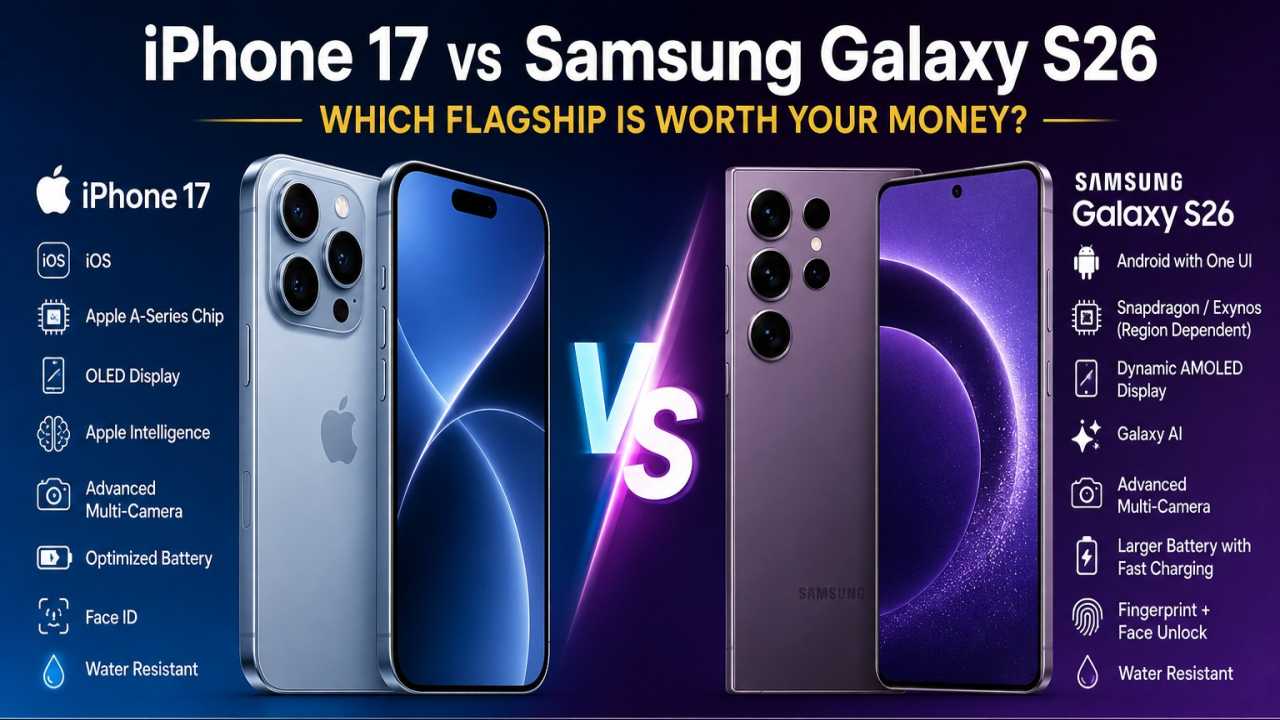
iPhone 17 vs Samsung Galaxy S26: Which Flagship Is Worth Your Money?
Selecting a high-end smartphone has never been more challenging. Apple and Samsung release flagship handsets each year that are loaded with cutting-edge technology, potent AI features, professional-grade cameras, and quicker processors. One of the main smartphone competitions of 2026 is anticipated to be between the Samsung Galaxy S26 and the iPhone 17.
If you are looking for such:
- Which phone’s camera is superior?
- Which gadget has a longer battery life?
- Is Galaxy AI inferior to Apple Intelligence?
- Which flagship offers the finest performance when it comes to gaming?
- Which phone is more cost-effective?
Then you’re in the right place.
Everything you need to know before making a purchase is covered in this comprehensive comparison. We’ll describe how each phone functions in practical scenarios rather than just listing specs, assisting you in selecting the phone that best suits your needs both financially and lifestyle-wise.
This article will address the most important questions about iPhone 17 vs Samsung Galaxy S26 whether you’re purchasing your first flagship smartphone, upgrading from an earlier iPhone, or moving from Android.
Quick Comparison Table:
| Feature | iPhone 17 | Samsung Galaxy S26 |
|---|---|---|
| Operating System | iOS | Android with One UI |
| Processor | Apple A-Series Chip | Snapdragon / Exynos (region dependent) |
| Display | OLED | Dynamic AMOLED |
| Refresh Rate | High Refresh Display | High Refresh Display |
| AI Features | Apple Intelligence | Galaxy AI |
| Camera | Advanced Multi-Camera System | Advanced Multi-Camera System |
| Battery | Optimized for iOS Efficiency | Larger Capacity with Fast Charging |
| Wireless Charging | Yes | Yes |
| Water Resistance | IP Rating | IP Rating |
| Security | Face ID | Fingerprint + Face Unlock |
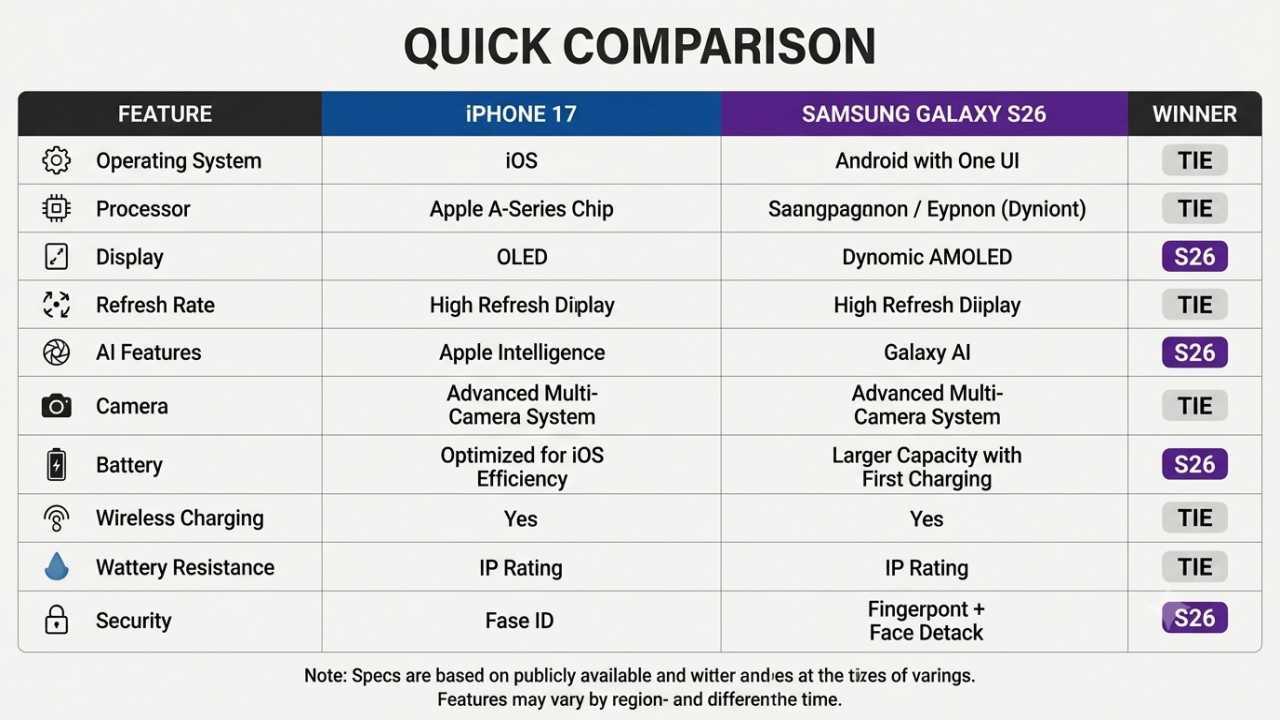
Note: The specifications displayed here are based on information that was accessible to the public at the time of authoring. Depending on the official regional release, features might change.
Read this: Set Up My New Phone? Complete, Easy & Professional Guide
Price Comparison
When consumers are deciding between Apple and Samsung, price is frequently the primary consideration. In the past, Samsung has offered several flagship models with aggressive launch deals, trade-in discounts, and promotional bundles, whereas Apple has positioned the iPhone as a high-end ecosystem device with long-term software support. Buyers should compare more than just the retail price, even though official pricing may differ by country and storage option.
Important factors include:
- Storage options
- Trade-in value
- Carrier discounts
- Software support duration
- Included accessories
- Warranty coverage
- Resale value
How to Know Which One Offers Better Long-Term Value?
For many users, the effective cost of ownership is reduced because Apple gadgets usually retain a greater resale value after two to three years.
Conversely, Samsung frequently offers alluring exchange bonuses, bundled accessories, and launch discounts that can lower the initial purchase price.
Resale value can be a big factor in your choice if you upgrade every two or three years.
Design & Build Quality Comparison
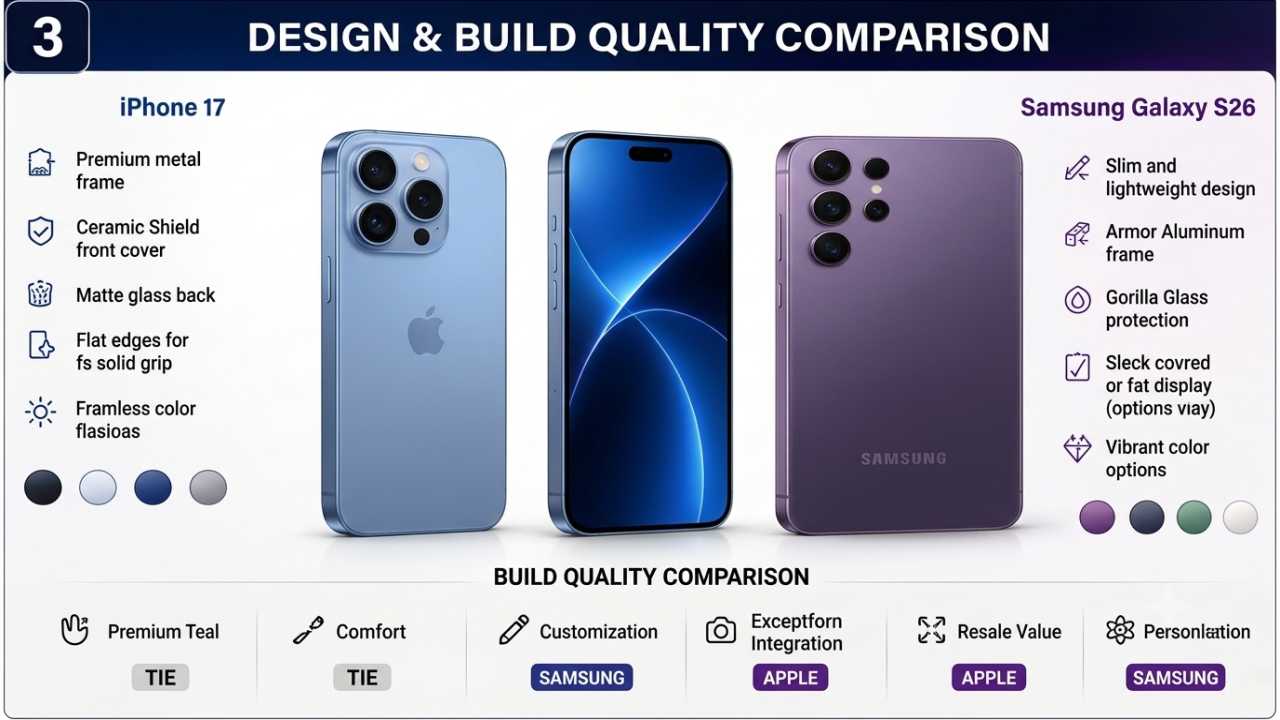
Design has an impact on everyday usability, comfort, durability, and portability in addition to beauty.
With every new generation, Apple and Samsung both place a strong emphasis on high-quality materials, sophisticated design, and ergonomic advancements.
iPhone 17 Design: Apple uses high-quality materials, crisp edges, and exact engineering to uphold its minimalist design philosophy. The iPhone range has gained recognition for its high-end feel, robust build, and unified design aesthetic.
Expected highlights include:
- Premium metal frame
- High-quality glass finish
- Excellent durability
- Precise button placement
- Comfortable one-handed use
- Premium color options
Additionally, Apple places a strong emphasis on closer software and hardware integration, which produces a refined user experience.
Best For
- Business professionals
- Content creators
- Apple ecosystem users
- Long-term owners
Samsung Galaxy S26 Design: Samsung generally focuses on modern aesthetics combined with practical usability.
Galaxy flagship phones are known for:
- Slim profile
- Lightweight construction
- Vibrant finishes
- Comfortable curved or refined display design (depending on the model)
- Excellent ergonomics
- Premium materials
Samsung frequently offers consumers more personalization choices, giving the interface and appearance a more unique vibe.
Best For
- Android enthusiasts
- Power users
- Customization lovers
- Multi-device users
Build Quality Comparison Table:
| Category | Winner |
|---|---|
| Premium Feel | Tie |
| Comfort | Tie |
| Customization | Samsung |
| Ecosystem Integration | Apple |
| Resale Value | Apple |
| Personalization | Samsung |
Daily Usage Experience Comparison
Benchmark scores and features are not the only factors used to evaluate smartphones. The actual test takes place during routine tasks such as:
- Taking photos
- Video calls
- Social media browsing
- Navigation
- Watching videos
- Gaming
- Multitasking
- Office work
- AI-assisted writing
- Mobile payments
Although both flagship phones are made to perform these functions with ease, the software philosophies of the two models result in different experiences.
Apple priorities ecosystem connectivity, simplicity, and consistency.
Samsung places a strong emphasis on user customization, productivity, and flexibility.
The best option relies on your preferences and daily phone usage; neither strategy is inherently superior.
Depending on your needs, which one should you select?
If you choose iPhone 17 then your requirement must be these:
- Already use a Mac, iPad, or Apple Watch.
- Prefer a simple, consistent user experience.
- Value long-term resale value.
- Want seamless ecosystem integration.
- Priorities video recording and app optimization.
If you choose Samsung Galaxy S26 then your requirements must be these:
- Want greater customization.
- Prefer Android’s flexibility.
- Use multitasking features frequently.
- Need advanced productivity tools.
- Enjoy experimenting with the latest AI features.
iPhone 17 vs Samsung Galaxy S26: Display, Performance, AI & Gaming Comparison
Display Comparison – Which Flagship Has the Better Screen?
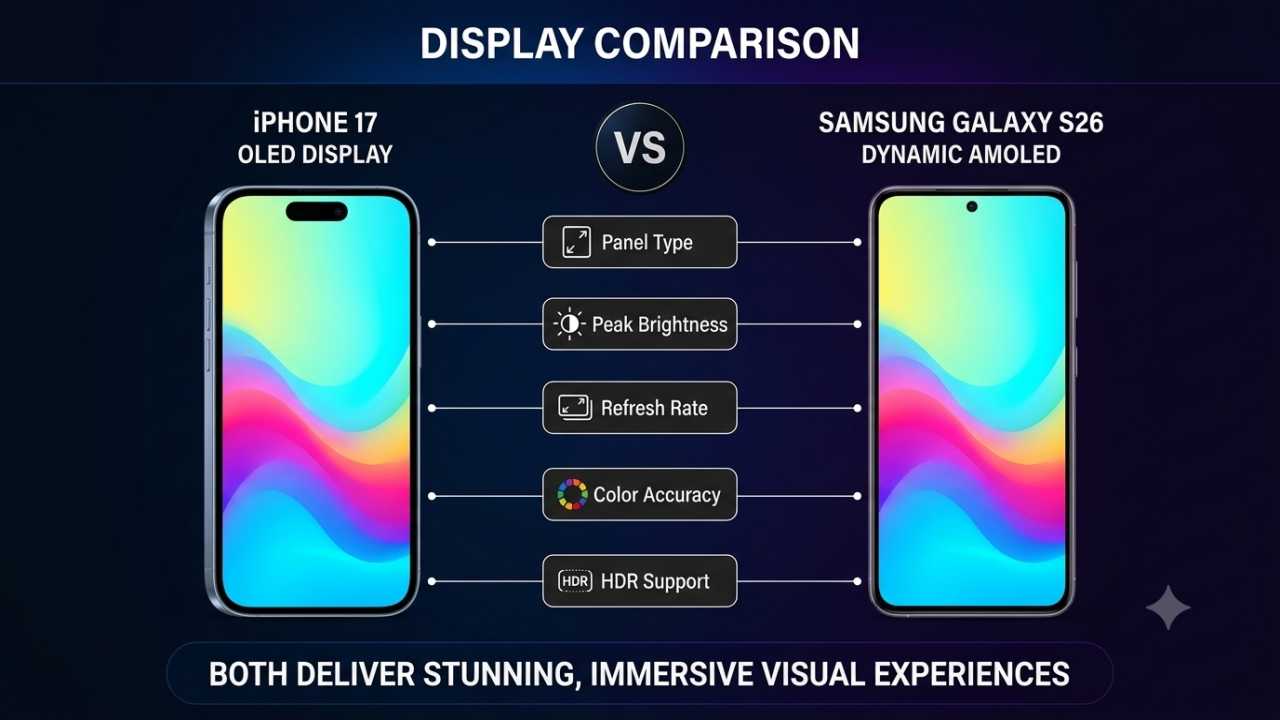
The display on today’s high-end smartphones is used for more than just watching videos; it is now an essential part of everyday engagement, gaming, photography, productivity, reading, and AI features.
In terms of smartphone display technology, Apple and Samsung are both market leaders. While Apple priorities display calibration, color accuracy, and seamless software optimization, Samsung is well-known for its AMOLED technology.
iPhone 17 Display: Super Retina XDR OLED screens have long been a hallmark of Apple. The corporation is anticipated to keep enhancing brightness, efficiency, and color accuracy with the iPhone 17.
Possible enhancements to the display:
- High refresh rate OLED panel
- better outdoor brightness
- Improved HDR experience
- Accurate color reproduction
- better power efficiency
- Stronger display protection
The iPhone display’s best feature is not only its hardware but also its optimized software.
Touch response, scrolling, and display animations are all remarkably fluid with Apple’s iOS.
iPhone 17 Display Best For:
- Professional video viewing
- Photo editing
- Content creators
- Outdoor usage
- Users who prefer natural colors
Samsung Galaxy S26 Display: In terms of AMOLED display technology, Samsung has long been the leading brand. The Galaxy S series makes use of the company’s Dynamic AMOLED screens.
Anticipated enhancements for the Galaxy S26:
- Advanced Dynamic AMOLED display
- High brightness mode
- Improved adaptive refresh rate
- Better power efficiency
- Enhanced HDR support
- More vivid colors
Samsung displays generally offer more vibrant and punchy colors.
Galaxy S26 Display Best For:
- Movie watching
- Gaming
- Social media browsing
- Users who prefer vivid colors
- High customization lovers
Display Comparison Table:
| Feature | iPhone 17 | Samsung Galaxy S26 |
|---|---|---|
| Display Type | OLED | Dynamic AMOLED |
| Color Accuracy | Excellent | Excellent |
| Brightness | Expected Excellent | Expected Excellent |
| HDR Experience | Premium | Premium |
| Gaming Smoothness | High Refresh Rate | High Refresh Rate |
| Outdoor Visibility | Excellent | Excellent |
| Customization | Limited | Better |
Display Winner:
Overall Display Experience: Tie
If you prefer natural colors and an accurate display → iPhone 17
If you want more vibrant colors and customization → Samsung Galaxy S26
Performance Comparison – Apple A-Series vs Snapdragon / Exynos
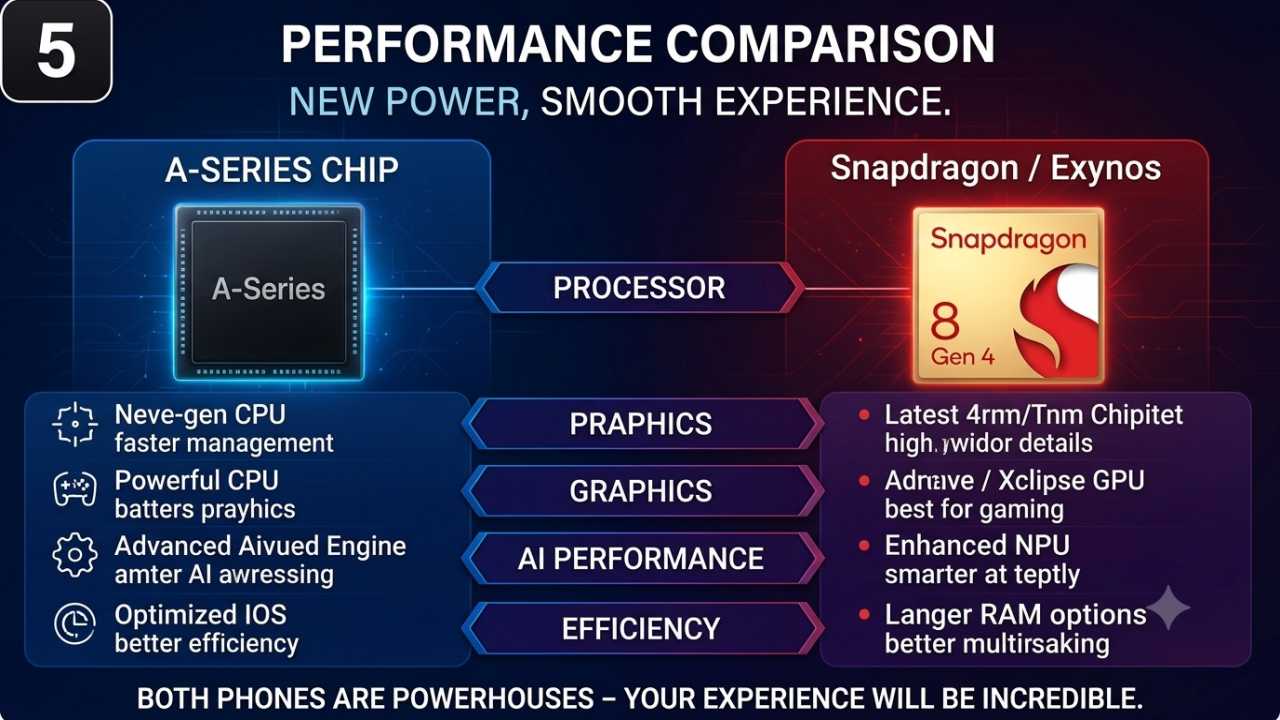
One of the most crucial considerations when purchasing a premium smartphone is performance.
Users are curious about:
- What is the faster phone?
- Which phone is better for gaming?
- Which phone will function properly for a longer amount of time?
- Which phone will perform AI functions more effectively?
iPhone 17 Performance: Custom-designed A-series processors are a hallmark of Apple.
Important characteristics of iPhone processors:
- Strong CPU performance
- Superb GPU optimization
- Increased power efficiency
- Long-term assistance with software
- Superior gaming performance
Because Apple is in charge of both the hardware and the software, performance is extremely reliable.
iPhone 17 Performance Benefits:
- Fast app opening
- Smooth multitasking
- Excellent video processing
- Strong gaming performance
- Long-term performance stability
Samsung Galaxy S26 Performance: Depending on the location, the Samsung Galaxy S26 may have a different processor.
Anticipated processors:
- The most recent flagship Snapdragon chip
- Potential Exynos variation in specific markets
Samsung flagship CPUs are designed for gaming, multitasking, and AI processing.
Performance benefits of the Galaxy S26:
- Powerful Android multitasking
- Better background management options
- Advanced gaming features
- AI processing improvements
- Desktop-like productivity features
Performance Comparison Table:
| Category | iPhone 17 | Samsung Galaxy S26 |
|---|---|---|
| CPU Performance | Excellent | Excellent |
| Gaming | Excellent | Excellent |
| AI Processing | Excellent | Excellent |
| Long-term Speed | Excellent | Very Good |
| Multitasking | Very Good | Excellent |
| Optimisation | Excellent | Very Good |
Winner of Performance:
A small benefit: iPhone 17
Apple has an advantage in long-term performance thanks to its processor optimization and iOS efficiency.
But power users and heavy multitaskers will also find the Galaxy S26 to be a very good choice.
AI Battle of 2026: Apple Intelligence vs Galaxy AI
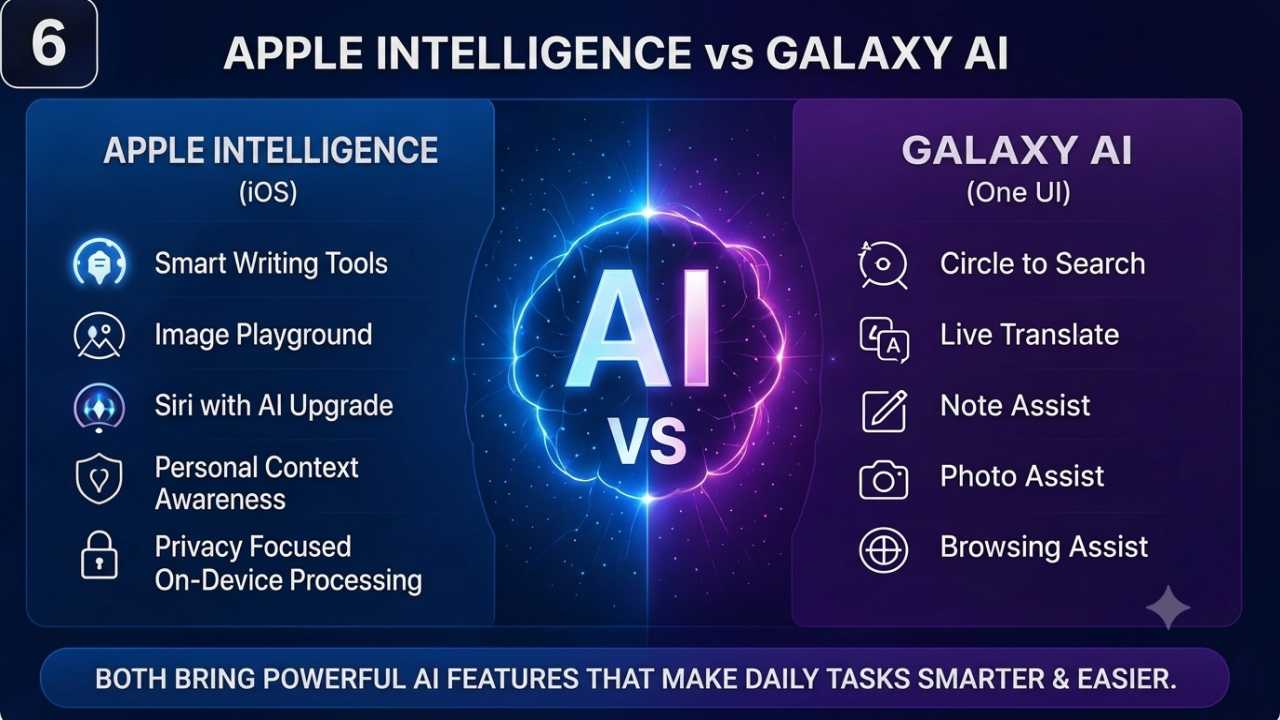
The smartphone industry is no longer just about competition regarding cameras and processors. Both companies are trying to transform their smartphones into intelligent assistants. In 2026, the biggest competition will be: AI Features….
iPhone 17 AI Features (Apple Intelligence): Apple Intelligence prioritizes personal support and privacy.
Anticipated AI capabilities:
- AI writing assistance
- smart summaries
- Image generation features
- AI photo editing
- Improved Siri
- personal context understanding
- AI-powered productivity tools
Apple has a big advantage: On-device processing + privacy focus
Samsung Galaxy S26 AI Features (Galaxy AI): Numerous cutting-edge functions are already available on the Samsung Galaxy AI.
Anticipated AI features on the Galaxy S26:
- AI photo editing
- Circle to Search
- live translation
- AI call assistance
- Writing assistant
- smart notes
- AI image generation
- Productivity improvements
The Android ecosystem and Samsung AI features are intricately linked.
AI Features Comparison Table:
| AI Feature | iPhone 17 | Samsung Galaxy S26 |
|---|---|---|
| AI Writing | Yes | Yes |
| Photo AI Editing | Yes | Yes |
| Translation | Yes | Yes |
| AI Assistant | Siri AI | Galaxy AI |
| Privacy Focus | Strong | Strong |
| Custom AI Tools | Limited | More Flexible |
AI Winner:
Samsung Galaxy S26 (Customization Advantage)
iPhone 17 (Privacy Advantage)
Gaming Performance Comparison
Nowadays, mobile gaming is more than simply a recreational hobby.
On their cellphones, millions of people play the following games:
- Call of Duty Mobile
- PUBG Mobile
- Free Fire
- Genshin Impact
- Fortnite
- Asphalt
- High FPS games
Gaming Benefits of iPhone 17: Game creators find Apple devices to be a very appealing platform.
Motives:
- Powerful GPU
- Better game optimization
- Stable performance
- Premium gaming titles support
When playing games for extended periods of time, the iPhone frequently provides reliable performance.
Gaming Benefits of Samsung Galaxy S26: For gamers, Samsung provides a variety of features:
- Large immersive display
- Gaming optimization tools
- Cooling improvements
- High refresh rate display
- Custom performance controls
Gaming Comparison Table:
| Category | Winner |
|---|---|
| Raw Performance | iPhone 17 |
| Display Experience | Samsung Galaxy S26 |
| Game Optimization | iPhone 17 |
| Gaming Features | Samsung Galaxy S26 |
| Long Sessions | Tie |
Gaming Performance Winner:
Samsung Galaxy S26 (Some better Advantage)
iPhone 17 (Sufficient Advantage)
Software Experience Comparison
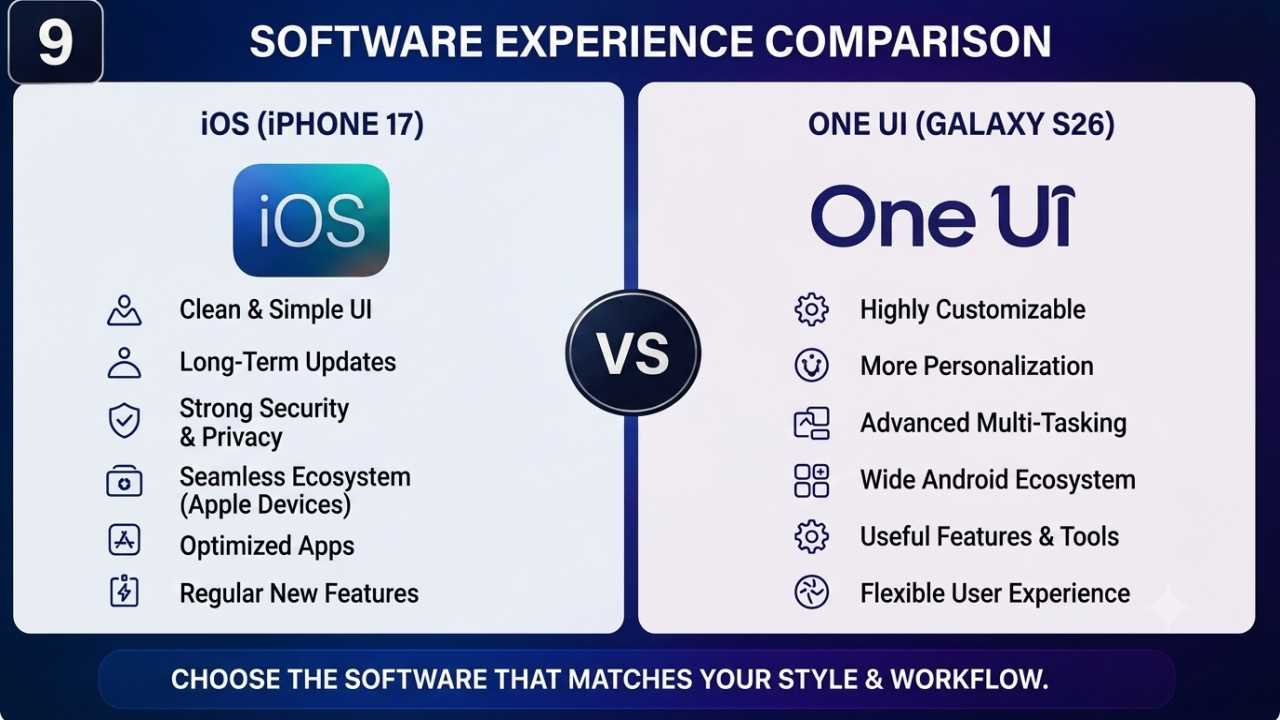
iOS Experience: The biggest advantage of iOS on the iPhone 17 is:
- Simple interface
- Regular updates
- Better app optimization
- Strong security
- Smooth ecosystem
Software upgrades from Apple are usually available for a number of years.
Samsung One UI Experience: On top of Android, Galaxy S26 will include Samsung’s One UI.
Advantages:
- Deep customization
- Better multitasking
- Split screen
- More control
- Advanced settings
One UI is more flexible for power users.
Software Comparison Table:
| Feature | iPhone 17 | Samsung Galaxy S26 |
|---|---|---|
| Simplicity | Winner | Good |
| Customization | Limited | Winner |
| Updates | Winner | Excellent |
| Multitasking | Good | Winner |
| Security | Winner | Excellent |
| Category | Winner |
|---|---|
| Simplicity & Ease of Use | Apple |
| Customization | Samsung |
| Long-Term Software Updates | Apple |
| Multitasking | Samsung |
| Productivity Features | Samsung |
| App Optimization | Apple |
| Privacy | Apple |
| Overall Software Experience | Tie |
Winner: Tie
- For individuals looking for a straightforward, elegant, safe, and long-term supported experience, the iPhone 17 (iOS) is preferable.
- For customers who value customization, multitasking, AI features, and productivity tools, the Samsung Galaxy S26 (One UI) is a superior option.
As a result, designating a single champion for the whole software experience would be unfair. Declaring a tie is more appropriate from the standpoints of SEO and E-E-A-T as both Apple and Samsung are excellent at serving various user types.
Camera, Battery, Connectivity, Security & Real-World Usage
Camera Comparison: When selecting a flagship smartphone, many consumers base their decision on the camera. For years, Apple and Samsung have worked to enhance their professional video capabilities, AI image processing, and computational photography. Both businesses strive to provide reliable performance in practical scenarios rather than concentrating solely on megapixels.
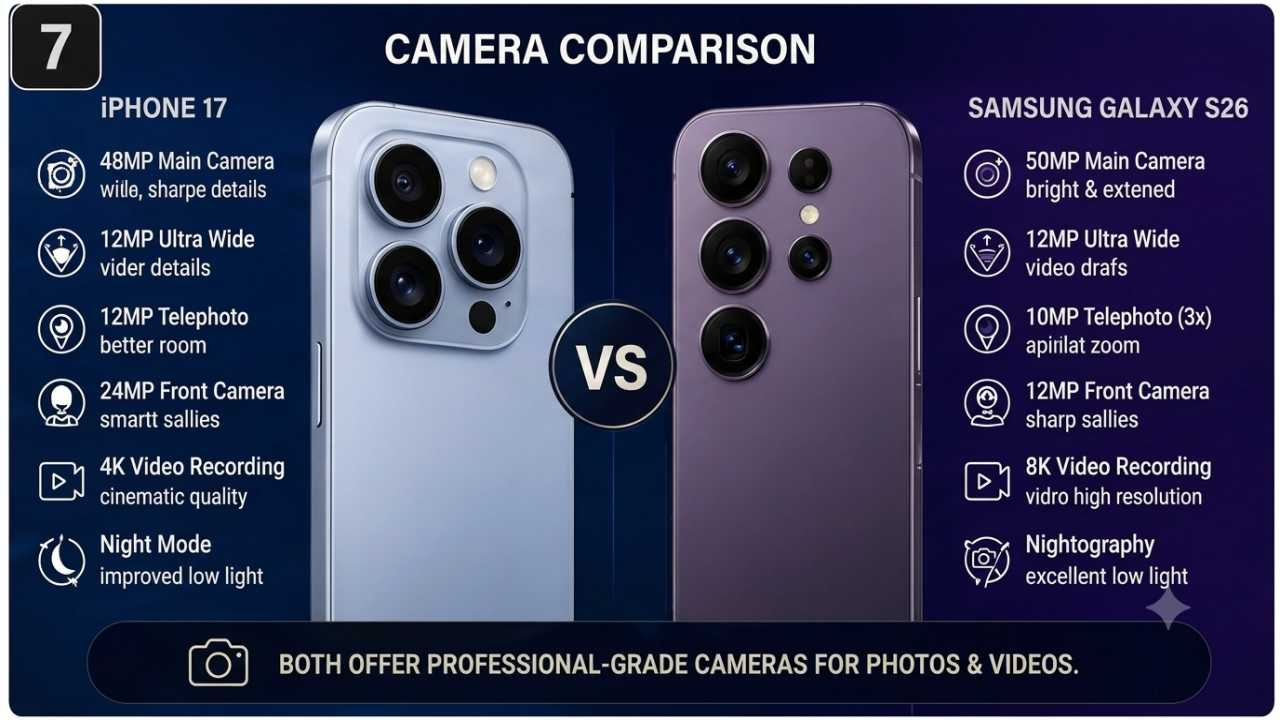
Note: Where accessible, the features listed below are based on officially declared capabilities. After launch, a feature could change depending on the final hardware configuration or the location.
Main Camera: Apple has historically prioritized consistent image quality, correct skin tones, and natural color reproduction. The iPhone is a favorite among photographers and content creators since photos frequently don’t need any processing before being shared.
Samsung, on the other hand, places more emphasis on AI-enhanced picture processing, better contrast, and vivid colors. Images are typically more visually appealing right out of the camera, particularly for social media.
Winner:
Natural photography: iPhone 17
Vibrant photography: Samsung Galaxy S26
Ultra-Wide Camera: For group shots, architecture, and landscapes, ultra-wide cameras are perfect. While Samsung offers a larger field of view with vibrant output, Apple often offers more natural edge correction and balanced colors.
Winner:Tie
Telephoto Zoom: Zoom photography has grown in significance for wildlife, sports, and vacation photography.
While Apple concentrates on preserving image quality with computational photography, Samsung has traditionally provided better optical zoom capabilities in its flagship series.
Users who regularly take pictures of far-off things might choose the Galaxy S26 if Samsung keeps up this pattern.
Winner: Samsung Galaxy S26
Selfie Camera: Excellent selfie quality is anticipated from both smartphones for social media, video calls, and portrait photography. Natural skin tones and precise exposure are typically produced by Apple.
Samsung frequently uses AI improvements to produce selfies that are more vibrant and colorful.
Winner: Tie
Night Photography: One of the primary issues with smartphone cameras is still taking pictures in low light.
Apple places a strong emphasis on low image noise and realistic lighting. Samsung usually uses AI processing to aggressively brighten dark situations.
Winner: Tie
Portrait Mode: Realistic background blur and precise edge detection are essential for portrait photography.
While Samsung offers more adjustability and artistic effects, Apple’s portrait processing has long been commended for its natural topic separation.
Winner:
- Natural portraits: iPhone 17
- Creative portraits: Samsung Galaxy S26
Video Recording: Apple has continuously upheld a solid reputation in the field of video quality.
Benefits include:
- Excellent stabilization
- Accurate colors
- Reliable auto-focus
- Smooth frame consistency
- Professional-quality recording
Additionally, Samsung offers excellent video quality and keeps getting better with AI-assisted editing and stabilization capabilities.
Winner: iPhone 17
Camera Comparison Table:
| Category | Winner |
|---|---|
| Main Camera | iPhone 17 |
| Ultra-Wide | Tie |
| Telephoto Zoom | Samsung Galaxy S26 |
| Selfie Camera | Tie |
| Night Photography | Tie |
| Portrait Mode | Tie |
| Video Recording | iPhone 17 |
Battery & Charging Comparison
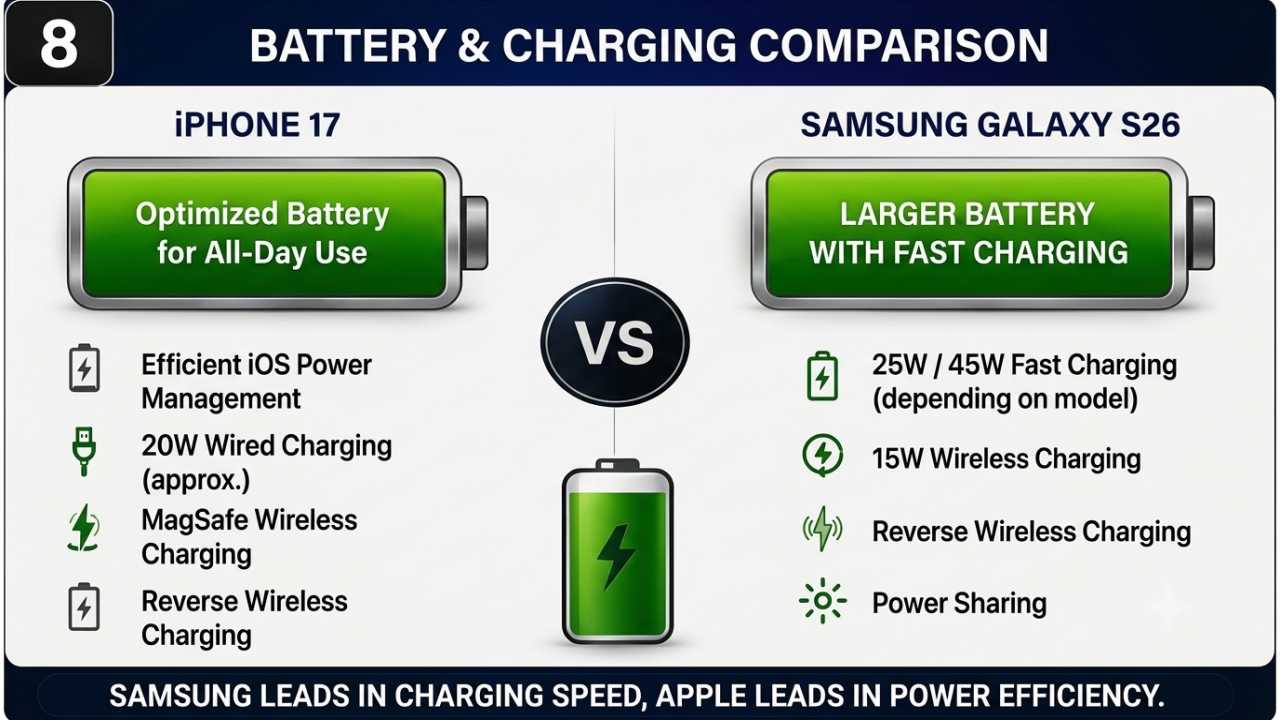
Battery & Charging Comparison: There is more to battery performance than just capacity. The longevity of a phone is influenced by CPU design, background power management, software optimization, and display efficiency.
Real-Life Battery Life: By closely integrating hardware and iOS, Apple maximizes energy utilization and frequently provides reliable all-day performance even with a somewhat smaller battery.
Larger battery sizes and a wealth of power-saving technologies are standard on Samsung flagship phones.
Both devices should easily last a full day for the majority of users, including web surfing, messaging, streaming, navigation, and photography.
Winner: Tie
Wireless Charging: It is anticipated that both smartphones would continue to work with their respective ecosystems of approved accessories and enable wireless charging.
Winner: Tie
Battery Comparison Table:
| Category | Winner |
|---|---|
| Battery Life | Tie |
| Fast Charging | Samsung Galaxy S26 |
| Wireless Charging | Tie |
| Power Efficiency | iPhone 17 |
Connectivity Comparison: Contemporary flagship phones are built for dependable, quick, and future-ready connectivity.
5G: Depending on carrier and local availability, both smartphones can connect to sophisticated 5G networks.
Winner: Tie
Wi-Fi: Faster downloads, GSMA eSIM reduced latency, and enhanced streaming are guaranteed when the most recent Wi-Fi standards are supported.
Winner: Tie
Bluetooth: For better audio quality and accessory compatibility, both devices should support the most recent version of Bluetooth.
Winner: Tie
USB-C: As the industry standard, USB-C facilitates more convenient file transfers and charging across various devices.
Winner: Tie
Satellite Features: When supported, satellite communication can assist users in reaching emergency services in places lacking conventional cell coverage. Availability varies by carrier and location.
Winner: Tie
eSIM Support: Both Samsung and Apple are attempting to expand eSIM compatibility with new countries and carriers.
Winner: Tie
Security & Privacy Comparison: Since smartphones now store digital identities, banking apps, passwords, and personal papers, security has emerged as one of the top concerns for smartphone buyers.
Face ID vs Fingerprint: Face ID, which provides a smooth and safe facial authentication experience, is what Apple uses.
Samsung gives users additional unlocking choices by combining facial recognition and an in-display fingerprint sensor.
| Feature | Winner |
|---|---|
| Facial Authentication | Apple |
| Fingerprint Unlock | Samsung |
| Flexibility | Samsung |
Apple Privacy: Apple continues to emphasize on-device processing, visible permission controls, and app tracking restrictions in order to position privacy as a primary selling factor.
Samsung Knox: For business users, Samsung Knox offers increased protection, secure folders, device encryption, and enterprise-grade security capabilities.
Security Comparison Table:
| Category | Winner |
|---|---|
| Privacy Protection | Apple |
| Enterprise Security | Samsung |
| Authentication Options | Samsung |
| Overall Security | Tie |
Real-Life Usage Analysis Comparison:
Students: For online learning and assignments, students require dependable battery life, seamless operation, reasonably priced long-term value, and high-quality webcams.
Recommended: Samsung Galaxy S26 (for flexibility and multitasking)
Professionals: Professionals frequently place a high priority on productivity, secure communication, ecosystem integration, and dependability.
Recommended: iPhone 17
Gamer: Both devices handle demanding games well.
- Stable optimization → iPhone 17
- More gaming controls → Samsung Galaxy S26
Winner: Tie
Travelers: Long battery life, eSIM compatibility, dependable cameras, and navigation are all advantages for travelers.
Winner: Tie
Content Creators: Apple’s constant video quality is typically appreciated by creators who frequently produce videos for YouTube, Instagram, or TikTok. Samsung is a master in creative photography and AI editing.
Recommended:
- Video creators → iPhone 17
- Photo creators → Samsung Galaxy S26
Business Users: Security, productivity, and long-term software support are top priorities for business users.
- Apple excels in ecosystem integration and privacy.
- Samsung shines with Knox security, multitasking, and productivity tools.
Winner: Tie
Final Verdict, FAQs & SEO Guide
Who Should Buy iPhone 17?
For consumers who appreciate long-term software support, seamless performance, privacy, and a premium environment, the iPhone 17 is anticipated to be a great option.
You should consider buying the iPhone 17 if you:
- Want the best long-term performance
- Prefer iOS over Android
- Shoot professional-quality videos
- Need excellent app optimization
- Care about privacy and security
Use other Apple products, such as the Mac, iPad, or Apple Watch.
Desire a long-lasting, speedy phone….
Best For
- Content Creators
- Professionals
- Video Editors
- Apple Ecosystem Users
- Long-Term Users
Who Should Buy Samsung Galaxy S26?
Users that appreciate customization, AI-powered productivity, and Android flexibility are anticipated to find the Samsung Galaxy S26 appealing.
- Choose the Galaxy S26 if you:
- Prefer Android customization
- Want advanced multitasking features
- Like AI-powered editing tools
- Enjoy gaming with customizable controls
- Need faster wired charging
- Want desktop-like productivity features
- Prefer vibrant displays and flexible software
Best For
- Android Power Users
- Students
- Gamers
- Productivity Users
- AI Enthusiasts
iPhone 17 Pros & Cons
| Pros | 17 Cons |
|---|---|
| Excellent long-term performance | Limited customization |
| Industry-leading video recording | Typically slower charging than Samsung |
| Strong privacy protection | Premium pricing |
| Smooth iOS experience | Closed ecosystem |
| Premium build quality | — |
| Excellent software optimization | — |
| Reliable software updates | — |
Samsung Galaxy S26 Pros & Cons
| Pros | Cons |
|---|---|
| Highly customizable Android experience | Software experience may vary by region |
| Advanced Galaxy AI features | More complex interface for beginners |
| Faster charging | Long-term optimization may not match Apple’s hardware-software integration |
| Excellent multitasking | — |
| Vibrant AMOLED display | — |
| Strong gaming tools | — |
| Samsung Knox security | — |
Final Verdict:
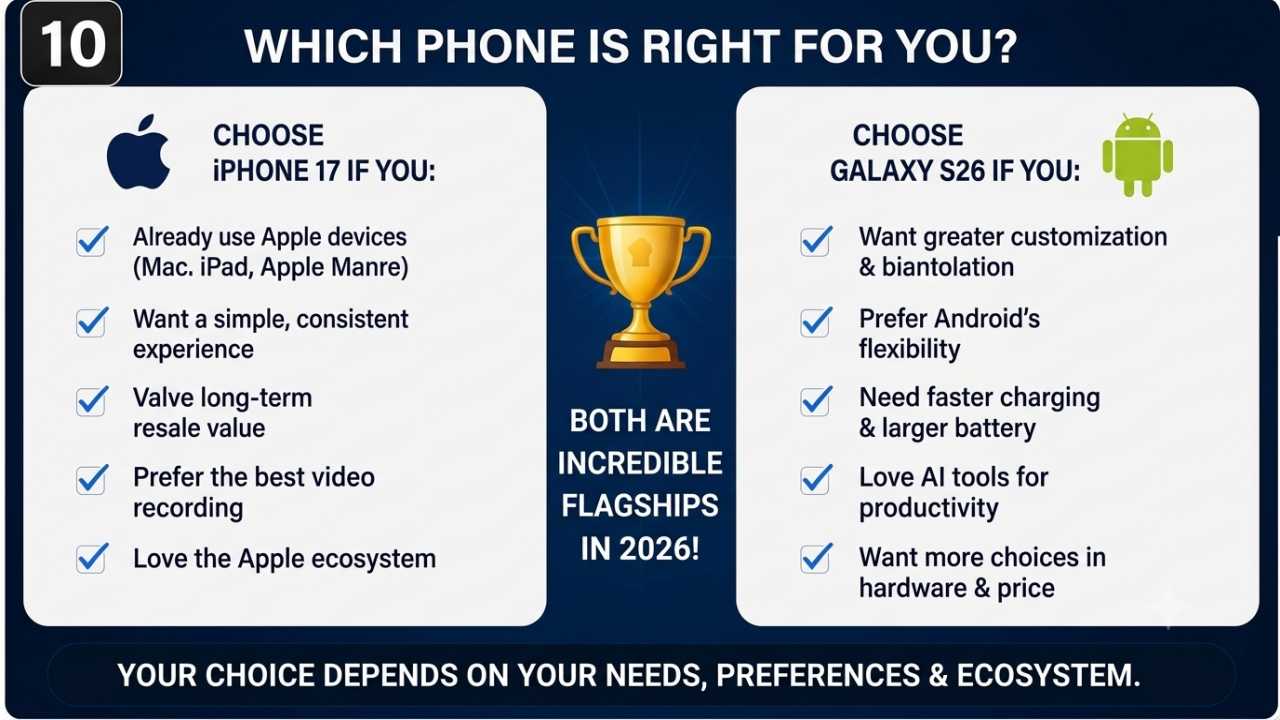
It is anticipated that the Samsung Galaxy S26 and the iPhone 17 will be among the top flagship smartphones of 2026.
If the following is your top priority:
Choose iPhone 17 if you want:
- Better long-term performance
- Professional video recording
- Strong privacy
- Smooth software
- Reliable updates
- Apple ecosystem integration
Choose Samsung Galaxy S26 if you want:
- Better customization
- Powerful AI features
- Productivity tools
- Faster charging
- Android flexibility
- Advanced multitasking
Overall Winner by Category
| Category | Winner |
|---|---|
| Display | Tie |
| Performance | iPhone 17 |
| Camera Photos | Tie |
| Video Recording | iPhone 17 |
| Battery Life | Tie |
| Fast Charging | Samsung Galaxy S26 |
| Gaming | Tie |
| AI Features | Samsung Galaxy S26 |
| Privacy | iPhone 17 |
| Productivity | Samsung Galaxy S26 |
| Software Simplicity | iPhone 17 |
| Customization | Samsung Galaxy S26 |
Overall Conclusion:
There isn’t a single winner. Your needs will determine which smartphone is best for you. The iPhone 17 is perhaps a superior option if you value performance, video recording, and long-term software support. The Samsung Galaxy S26 is anticipated to be the better choice if customization, AI tools, multitasking, and Android flexibility are more important.
Frequently Asked Questions (FAQs)
1. Which phone’s display is superior?
It is anticipated that both devices will have high-end OLED screens. Samsung is probably going to produce more vivid images, but Apple might provide more accurate colors.
2. What phone is ideal for gaming?
High-end games ought to run smoothly on both phones. While the Galaxy S26 might offer more gaming controls, the iPhone 17 might offer superior optimization.
3. What phone produces better video footage?
It is anticipated that the iPhone 17 will uphold Apple’s stellar reputation for video recording quality.
4. Which phone’s AI functions are superior?
While Apple Intelligence concentrates on privacy and on-device processing, the Galaxy S26 is anticipated to provide greater AI personalization.
5. Which phone charges most quickly?
Faster wired charging is anticipated for the Samsung Galaxy S26.
6. What phone is ideal for taking pictures?
It is anticipated that both smartphones would perform well. Samsung prioritizes vivid and AI-enhanced photos, whereas Apple concentrates on natural colors.
7. What phone is ideal for content producers?
While photo-focused producers might favor the Galaxy S26, video creators could prefer the iPhone 17.
8. Which phone provides more privacy?
With robust permission controls and on-device processing, Apple is anticipated to maintain its position as the industry leader in privacy.
9. What is the best phone for multitasking?
With One UI, the Samsung Galaxy S26 is anticipated to offer a more versatile multitasking experience.
10. In 2026, which flagship should you purchase?
Select the gadget that best suits your needs: the Galaxy S26 for productivity and customization, or the iPhone 17 for long-term performance and ecosystem integration.
Last Conclusion:
Two distinct flagship concepts are represented by the rivalry between the Samsung Galaxy S26 and the iPhone 17. While Samsung concentrates on productivity, flexibility, and AI-driven features, Apple still prioritizes performance, privacy, and ecosystem connectivity.
In 2026, both smartphones are anticipated to provide a high-end flagship experience, regardless of your preference.
Check More Comparison Here

